
What is NEST?
A Simple, Structured Framework for Teaching, Feedback, and Rapid-Cycle Coaching
NEST (Nurturing Education & Structured Teaching) is a simple, structured framework that helps faculty and learners turn everyday clinical encounters into intentional, coachable, growth-focused moments. It was designed for busy clinical settings where time is short, expectations vary, and feedback can easily become vague or inconsistent.
Rather than leaving bedside learning to chance, NEST gives educators and students a shared, repeatable process grounded in feedback literacy, coaching science, and competency-based medical education (CBME). With a clear objective, direct observation, structured reflection, focused feedback, and a specific goal for improvement, NEST makes teaching—and coaching—more intentional, transparent, and effective.
The NEST Teaching Flow
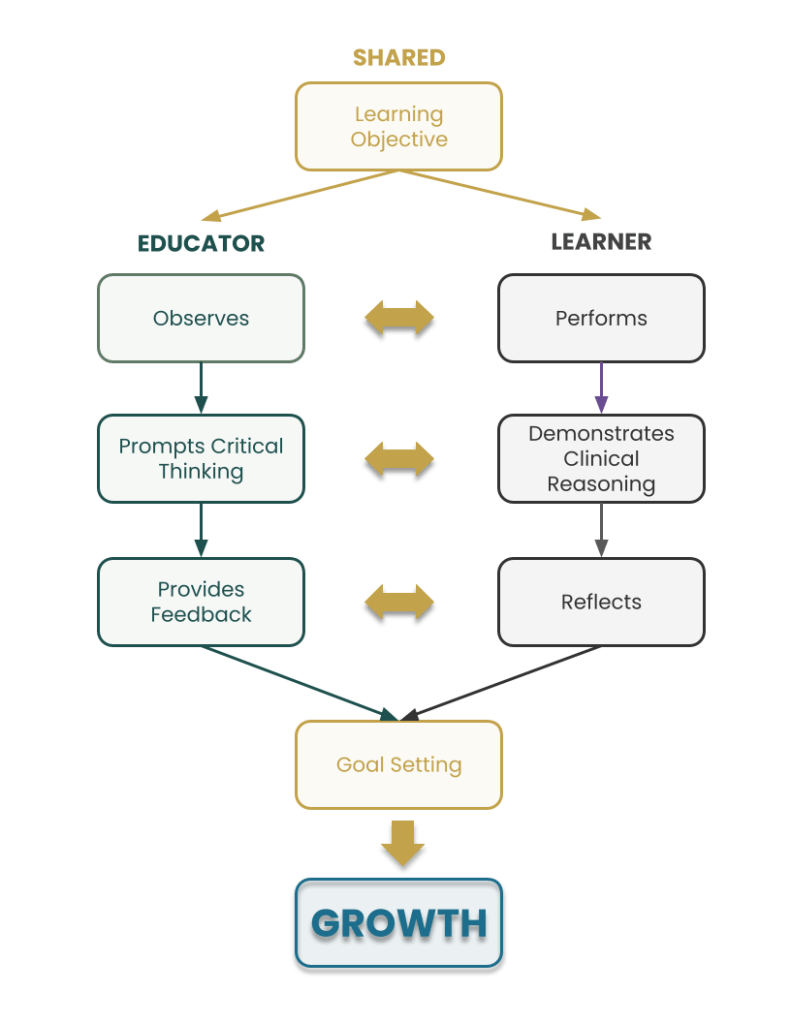
NEST guides each teaching encounter through five intentional steps:
- Shared Learner Objective
Faculty and learner briefly agree on what the learner will focus on in the upcoming encounter (e.g., focused history, newborn exam, communication, clinical reasoning). This creates alignment, reduces ambiguity, and sets the stage for both observation and coaching. - Learner Performs, Educator Observes
The learner leads the patient encounter while the educator deliberately observes. The emphasis is on seeing real performance, not hypothetical reasoning—an essential foundation for both high-quality feedback and coaching. - Learner Reflects
After the encounter, the learner reflects on what went well, what felt challenging, and what they hope to improve. This step builds self-awareness, feedback literacy, coaching readiness, and psychological safety. - Educator Provides Specific, Useful Feedback
The educator offers clear, behavior-based feedback tied to the objective—naming strengths and identifying 1–2 growth opportunities. Using structured “Why / What / How” prompts, educators can quickly shift from simple correction to micro-coaching, helping learners understand their reasoning and next steps. - Shared Goal for Improvement/Growth
Together, educator and learner set a concrete, achievable goal for the next encounter. This keeps learning moving forward and creates a rapid-cycle loop where growth is visible, intentional, and measurable.
NEST does not add extra tasks to the day—it simply provides a structured way to do what great teachers and coaches already try to do: observe, reflect, guide, and grow.
Why NEST Matters
Without structure, bedside teaching can feel rushed, inconsistent, or unclear. Learners may not know what is expected of them, and faculty may lack an easy way to organize observation, reflection, and feedback—or to incorporate coaching behaviors into routine care.
NEST supports both teaching and micro-coaching by:
- making expectations explicit
- ensuring every encounter has a shared focus
- centering learner reflection before feedback
- anchoring feedback in observable behaviors
- adding quick, intentional coaching prompts
- turning feedback into a concrete next-step goal
The result is a more predictable, psychologically safe learning environment where learners understand how to grow and faculty feel confident in their teaching and coaching.
For Faculty
NEST helps educators:
- reduce the mental load of “how do I teach—or coach—right now?”
- use a quick, repeatable structure for observation and feedback
- integrate rapid-cycle coaching into everyday encounters
- align bedside teaching with CBME and EPA-based assessment
For Learners
NEST helps learners:
- know what they are working on right now
- feel seen and supported in real time
- practice reflection as a normal part of clinical work
- build feedback literacy and coaching literacy
- receive specific, actionable guidance
- turn each encounter into a step toward growth
 Nurture Education Design